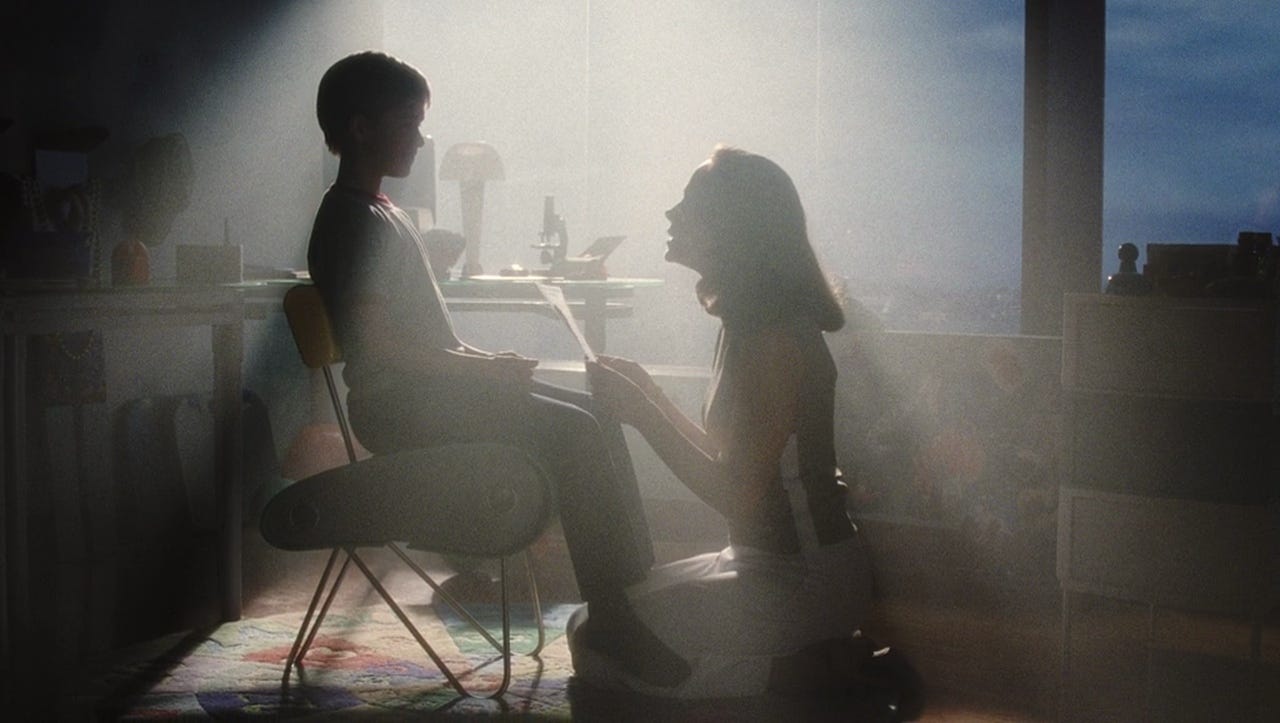

Based on feedback, I would guess that this article, which first appeared on June 25, 1998, is the most popular piece I ever published in the Chicago Reader. Although it’s been featured as a separate item for several years on their site, I noticed that, thanks to some of their recent user-unfriendly retoolings of that site — which makes it much harder to access anything and everything, including this article — my own list of my 100 favorite films at the end of this piece and the AFI’s list of the supposedly greatest 100 films somehow got scrambled together. [Update, 7/25/09: Checking back a day later, this now appears unscrambled.] This is mainly why I’ve decided to reprint the original piece here in Notes, with only a few minor modifications. I revised and expanded this piece still further in my book Movie Wars: How Hollywood and the Media Limit What Films We Can See, where it forms the sixth chapter. (I’m sorry that the English edition of this, which has a much better jacket, has become more scarce.) One of the main additions, on page 93, is a list of the 25 titles on the AFI list that I probably would have included on my own if I hadn’t wanted to create an all-new list for polemical purposes; six of these titles are illustrated at the tail-end of this piece. Read more
Reunion
From the Chicago Reader (April 12, 1991). — J.R.
It’s a pity that Jerry Schatzberg’s most recent picture — and one of his very best — has had to wait two years for its Chicago premiere. Adapted by Harold Pinter from a novel by Fred Uhlman, and shot in ‘Scope by Bruno De Keyzer, this French-English-West German production is a story about a Jewish lawyer in New York (Jason Robards) who’s returning to Stuttgart, Germany, after a 55-year absence to discover what happened during the early 30s to his best friend (Samuel West) — an ambassador’s son who didn’t share the racism of his aristocratic family. Most of the story is told in flashback (Christien Anholt plays the hero as a youth), and much of what’s impressive about its unfolding is the meticulous re-creation of Germany during the rise of Nazism (the superb production design is by the great Alexandre Trauner, who appears in a cameo in a warehouse office), as well as a sensitive (and perhaps timely) depiction of how the gradual changes in national thinking were reflected in everyday life. It’s a story that’s been told before, but seldom with such feeling for detail and nuance; one has to adjust to the curious mix between English dialogue and street signs in German, but the performances — including those by Francoise Fabian, Maureen Kerwin, Barbara Jefford, and Bert Parnaby in small parts — are impeccable (1989). Read more
Preface to the Korean Edition of GOODBYE CINEMA, HELLO CINEPHILIA
Written in October 2012 for what was supposed to have been the first (and, so far, only) translated edition of my most recent collection, although it has never come out. There is, however, a Korean translation of my earlier collection Essential Cinema (with a new Afterword, available here).
In retrospect, I’m sorry that I didn’t find some way of mentioning Lee Chang-dong’s extraordinary Poetry (2010), my favorite Korean film [see all the stills below] — and one that, incidentally, helps to explain the reason for my alienation from most of the other South Korean films I’ve seen and their excessive reliance on rape and serial killers as subjects (something that I was embarrassed to bring up in this Preface, written at the request of the publisher). This film in fact addresses the theme of rape and its role in Korean society quite directly. — J.R.
My acquaintance with cinephilia in South Korea is limited. My only first- hand knowledge comes from my experience as a juror on Indie Vision at the Jeonju International Film Festival in the Spring of 2006 and my acquaintance over a longer period with the brilliant and discerning critic and programmer Un-Seong Yoo, who worked for that festival for many years and, more recently, was my fellow juror on the New Directors jury at the San Sebastian Film Festival in the Fall of 2011. Read more
The First Cordelia [on IN MY FATHER’S SHADOW: A DAUGHTER REMEMBERS ORSON WELLES]
Posted in Moving Image Source on November 13, 2009. — J.R.
“The book you are about to read is not another biography of Orson Welles,” begins Chris Welles Feder’s In My Father’s Shadow: A Daughter Remembers Orson Welles (Algonquin Books of Chapel Hill). “It owes nothing to scholarly research and everything to firsthand knowledge.” Because this story by Welles’s oldest daughter is about neglect and absence as well as about love and presence, one feels from the outset that her very moving cri de coeur was written out of psychic necessity rather than out of any academic or commercial impulse — a passionate and even somewhat desperate attempt to lay certain ghosts to rest. And part of this book’s uncommon strength is that it ends on a positive note with a lot of hard-won wisdom, in spite of all the grief it recounts.
Orson Welles married three times and had a daughter from each marriage, although the woman who mattered the most in his life, at least during the last two decades, was none of these half-dozen women but Oja Kodar, his mistress and collaborator (mainly as actress and/or co-writer — on F for Fake, the unreleased The Other Side of the Wind, and many other unfinished or unrealized projects, such as The Dreamers). Read more
Global Discoveries on DVD: Digital Releases I Don’t Want & A Few Others That I Do
From the Spring 2023 Cinema Scope.
Who could it be at Vinegar Syndrome Films in the U.S. and/or Powerhouse Films in the U.K. who decided I was an aficionado of Mexican and/or Canadian wrestling? I haven’t been able to discover if Vinegar Syndrome and Powerhouse are distantly or closely related to one another—or if, on the contrary, separate publicists at each company arrived independently at the notion that I was an actual or potential wrestling buff. But the fact remains that unrequested check discs of Santo vs. Evil Brain and Santo vs. Infernal Men (both 1961) along with two more unrequested check discs devoted to an Italian Western with an equally unidiomatic, pidgin-English title (The Big Gundown, 1966), all from Powerhouse, turned up in my mailbox early this year, and these were soon followed by a finished Blu-Ray wrapped in cellophane of the no less unrequested and undesired Hitman Hart: Wrestling with Shadows, a 1998 Canadian documentary from Vinegar Syndrome.
Even if I accept the more probable and less paranoid explanation that much of our planet is currently undergoing a collective nervous breakdown over identity politics, leading to many mistaken surmises and false assumptions that each of us is making about the identities and interests of everyone else, I can’t fathom what might have inaugurated this trend in “restored” digital releases. Read more
Discovering Yasuzo Masumura: Reflections on Work in Progress
This essay was written between 1999 and 2001 for Movie Mutations: The Changing Face of World Cinephilia, a 2003 collection I coedited with Adrian Martin and wrote (or, more often, cowrote) many pieces for. This particular piece was part of a section of the book entitled “Two Auteurs: Masumura and Hawks” that I collaborated on with the great Japanese film critic Shigehiko Hasumi, which also included two dialogues with him and a lengthy essay by him about Howard Hawks. — J.R.
To appropriate one of the categories of Andrew Sarris’ The American Cinema, Yasuzo Masumura (1924-1986) is a “subject for further research”. My first encounter with his work was almost thirty years ago in Paris, where his Love For an Idiot (Chijin no ai, 1967), an updated adaptation of Junichiro Tanizaki’s 1924 novel Naomi, was playing under the title La chatte japonaise. (As I would discover much later, there are two other excellent Tanizaki adaptations in his oeuvre -– Manji [Swastika, 1964] and Tattoo [Irezumi, 1966].) Spurred by a twelve page spread in the October 1970 issue of Cahiers du cinéma –- perhaps the most extensive critical recognition he’s received to date in the West -– I found myself both shocked and intrigued by this depiction of the erotic delirium of a middle-aged factory worker over the much younger wife he trains, marries and loses. Read more
Myths of the New Narrative (and a Few Counter-Suggestions)
The following is taken from the online Moving Image Source, and the first introductiion is by David Schwartz. –J.R.
This essay was commissioned by the Museum of the Moving Image in 1988 for a catalogue accompanying the month-long, 150-film retrospective Independent America: New Film 1978-1988. The ambitious series, which took place during the Museum’s inaugural season, was an attempt to make a statement not just about the state of experimental filmmaking at the time but also about the Museum’s wide-ranging programming philosophy.
The underlying idea was to showcase films that were cinematically inventive, works that broke boundaries in form and content, subverted conventions, and created new hybrid forms. In this way, the series revealed the inadequacy of such confining labels as “avant-garde,” “fiction,” and “documentary,” and it also tried to reinvigorate the notion of what it means to be “independent.”
Before the commercial success of Sex, Lies, and Videotape and Pulp Fiction (and before the rise of home video), independent filmmakers made and showed their films in a world truly apart from Hollywood. To get their work seen, they would travel for months, with their 16mm film prints in tow, to colleges and media arts centers across the country. Read more
Historical Meditations in Two Films by John Gianvito
This article appeared in the Winter 2008-2009 issue of Film Quarterly. The Mad Songs of Fernanda Hussein remains for me one of the key American independent American features of the past decade or so, and it’s hard for me to think of another that’s more personally important to me. — J.R.
HISTORICAL MEDITATIONS IN TWO FILMS BY JOHN GIANVITO
by Jonathan Rosenbaum
It’s been gratifying to see the almost instant acclaim accorded to John Gianvito’s beautiful, fifty-eight-minute Profit Motive and the Whispering Wind (2007), especially after the relative neglect of his only previous feature-length film, the 168-minute The Mad Songs of Fernanda Hussein (2001).
The more recent film — a meditative, lyrical, and haunting documentary about grave sites that won the grand prix at the Entervues Film Festival in Belfort in 2007 and both a Human Rights Award and a special mention at the Buenos Aires Festival of Independent Film in 2008 — also received an award at the Athens International Film and Video Festival in Ohio and was named the year’s best experimental film by the National Society of Film Critics. (Full disclosure: I nominated Profit Motive for the last of these awards, and headed the jury of the same Buenos Aires film festival in 2001, which gave The Mad Songs its top prize.) Read more
EYES WIDE SHUT

This comes from the top of my 1999 ten-best column for the Chicago Reader in January 2000. — J.R.

Eyes Wide Shut. Part of what irked some reviewers about Kubrick’s eccentric masterpiece is one of the things I treasure about it -– its distance from its own period. This quality is shared by at least two sublime testament films released in the 60s to similar amounts of scorn, Carl Dreyer’s Gertrud (1964) and John Ford’s 7 Women (1966). Both of them are clearly set in earlier periods; Kubrick’s is purportedly set in present-day New York but was adapted from “Traumnovelle,” a 1926 novella by Arthur Schnitzler set in prewar Vienna. All three depend on highly stylized and subjective renderings of time and place that become an essential part of their memory-laden textures. (To correct two factual errors in my original review: the prewar setting of Schnitzler’s novella can be gleaned from a reference to Bohemia, not Czechoslovakia, and Schnitzler wasn’t a friend of Freud’s but an ambivalent contemporary reader of his work, though Freud did once refer to Schnitzler as his “doppelganger,” apparently because they held some similar notions about psychology.)

Like many an artist before him, Kubrick went from being part of his own time — for better and for worse, Dr. Read more
A Dozen Undervalued Movie Satires
Posted by DVD Beaver in January 2007 (http://www.dvdbeaver.com/film/articles/dozen_undervalued_movie_satires.htm) . — J.R.
| One reason why I haven’t gone earlier than 1940 in this chronological list is that satire depends on a certain amount of currency in order to be effective, and the further off we are in time from a given movie, the less likely it is to affect us directly. This isn’t invariably true, and it certainly doesn’t apply to literature: think of Voltaire’s Candide, first published in 1759, which probably seems more “up to date” today than Terry Southern and Mason Hoffenberg’s Candy, first published in 1958. But it’s also important to realize that one of the best ways to understand a historical period is to discover how it was ridiculed by its contemporaries.
|
Cassavetes’ Prelude and Postscript
This article was commissioned by the Torino Film Festival to accompany a John Cassavetes retrospective in November 2007, and was published there in a substantial catalogue/collection in Italian translation. I’m sorry I can’t do a better job of illustrating this: apart from some pictures of Cassavetes, Rowlands, and Carol Kane, there are no appropriate images available to me. I’m grateful, in any case, to Jim Healy and Emanuela Martini for asking me to write this. — J.R.
——————————————————-
Cassavetes’ Prelude and Postscript: The Original Shadows and A Woman of Mystery
by Jonathan Rosenbaum
——————————————————-
I consider myself unusually fortunate in having been able to see the original version of Shadows in January 2004. Shot in the spring of 1957 and screened publicly only four or five times, the first completed version of the first film of John Cassavetes had been considered irretrievably lost for almost half a century.
More specifically, I saw the first of two public projections at the Rotterdam International Film Festival of a good video transfer of the rediscovered 16-millimeter print, presented by Ray Carney, the man who rediscovered the print. After these two screenings, objections were raised by Cassavetes’ widow, Gena Rowlands, with the result that subsequent public screenings have been forbidden by her. Read more
Unified Theory [METROPOLIS]
This appeared in the August 16, 2002 issue of the Chicago Reader. I more recently had occasion to return to this film and some of my thoughts about it when I joined David Kalat to do an audio commentary on the expanded (and now nearly complete) version of Metropolis for the English DVD of Masters of Cinema. In fact, the essay below was used by Masters of Cinema in the accompanying booklet of their previous edition of the film, and an updated version of this piece appeared in the next one. — J.R.
Metropolis
**** (Masterpiece)
Directed by Fritz Lang
Written by Lang and Thea von Harbou
With Gustav Frohlich, Brigitte Helm, Alfred Abel, Rudolf Klein-Rogge, Fritz Rasp, Theodor Loos, and Heinrich George.
The internationalism of filmic language will become the strongest instrument available for the mutual understanding of peoples, who otherwise have such difficulty understanding each other in all too many languages. To bestow upon film the double gift of ideas and soul is the task that lies before us.
We will realize it! — Fritz Lang, in an article published in 1926
Lang’s utopian rallying cry, written in Germany during the editing of Metropolis, is well worth recalling today. Read more
PLACING MOVIES, Part 1: The Critical Apparatus (Introduction)
This is the Introduction to the first section of my first collection, Placing Movies: The Practice of Film Criticism (University of California Press, 1993). I’ve taking the liberty of adding a few links to some of the pieces of mine mentioned here which appear on this web site. — J.R.
Introduction
Although this entire book is devoted to film criticism as a practice, this section emphasizes this fact by dealing with film criticism directly as a subject. This includes both specific examinations of the work of other critics and polemical forays into questions about how critics and reviewers operate on a day-to-day basis. A broader look at the same topic might question whether film criticism as it’s presently constituted is a worthy activity in the first place — if in fact the public would be better off without it.
I should add that it’s the institutional glibness of film criticism in both its academic and mainstream branches — above all in the United States, where it seems most widespread and least justifiable — that has led me on occasion to raise this latter question. Speaking as someone who set out to become a professional writer but not a professional film critic, I’ve never felt that movie reviewing was an especially exalted activity, but I didn’t start out with any contempt or disdain for the profession either. Read more
Thinking about (Personal) History Lessons: The Movie Paintings of Manny Farber
This piece had a somewhat tortured history. Commissioned but rejected by Artforum (for reasons that were never explained) circa 1982, it first appeared in a special issue of New Observations (#36, 1983) edited by the late Gilberto Perez, entitled “Horses, Hegel and Film,” where by necessity the illustrations were relatively sparse. In its present form, it first appeared in the 12th issue of the online journal Rouge in 2008. Two excerpts from it are reprinted in a superb recent collection, Manny Farber: Paintings and Writings, that I’m proud to be part of. — J.R.
| 1. Manny Farber, Negative Space (New York: Da Capo, 1998), p. 361. | ‘The brutal fact is that they’re exactly the same thing’, Manny Farber replied in 1977 to an interviewer inquiring about the relationship between his dual activities as a painter and film critic. (1) The remark points to a two-part obsession that by now has persisted for more than four decades. A master at perceiving the delicate nuances of brutal facts, Farber has always had an uncanny knack for hitting on truths in a language of wisecracking braggadocio that eliminates any possibility of a dispassionate or precise scientific observation. With his feet firmly planted in the anonymous turf of an underground termite (to conflate two of his favourite terms), Farber paradoxically aims at a notion of bull’s-eye that can exist only in a marketplace context where objects and ideas compete for our attention. |
Under the Chador
From the Chicago Reader (April 6, 2001). This is also reprinted in my collection Essential Cinema.— J.R.
The Day I Became a Woman
***
Directed by Marzieh Meshkini
Written by Mohsen Makhmalbaf
With Fatemeh Cheragh Akhtar, Hassan Nabehan, Shabnam Toloui, Cyrus Kahouri Nejad, Azizeh Seddighi, and Badr Irouni Nejad.
“Aren’t you afraid?” some of my stateside friends asked before I visited Iran for the first time last February. “Only of American bombs,” I replied. Notwithstanding all of the things that are currently illegal there — such as men and women shaking hands or riding in the same sections of buses — I’m not sure I’ve ever been anyplace where people display more social sophistication in terms of hospitality, everyday courtesy, or sheer enterprise in the use of charm and persistence to get what they want. Some of this character came through in Divorce Iranian Style, a fascinating documentary that turned up at the Film Center a couple of years ago showing the aggressive resourcefulness of Iranian women in divorce court, despite the repressive laws they have to work with.
The locals I spoke to tended to be pessimistic about the reformist movement — regarding Mohammad Khatami about as skeptically as American liberals regarded Bill Clinton during his last year in office — but it also quickly became clear that some aspects of Iranian life are not defined by Islamic fundamentalism and that what might seem hopeless in one context might be possible in another. Read more
Patience Pays Off [I’M GOING HOME]
From the Chicago Reader (September 13, 2002). — J.R.
I’m Going Home
**** (Masterpiece)
Directed and written by Manoel de Oliveira
With Michel Piccoli, Antoine Chappey, Catherine Deneuve, John Malkovich, Leonor Baldaque, and Sylvie Testud.
It seems entirely fitting that I’m Going Home — a beautiful feature by Manoel de Oliveira, who turns 94 this December and is still going strong — should open in Chicago, at the Music Box, just after September 11. This 2001 French film by a Portuguese master who occasionally makes films in France is the kind of quiet masterpiece that fully registers only after you’ve seen it — a profound meditation on bereavement and other kinds of loss (including losing one’s way) as well as on everyday life and things right under our noses that we accept as “other,” including old age and art and different cultures.
The French DVD of this film has an interview with Oliveira in Portuguese, subtitled in French, in which he explains what this movie means to him. He speaks alternately about the film’s plot, which he calls a tragedy, the real incident that inspired it (a famous actor in his 70s forgot his lines while shooting a film), and what he calls the “tragedy of our civilization.” Read more
Daney in English: A Letter to Trafic
Written for and originally published (in French translation) in Trafic no. 37 (printemps 2001); also reprinted in my 2010 collection Goodbye Cinema, Hello Cinephilia. — J.R.
Chicago, November 13, 2000
Dear Jean-Claude, Patrice, Raymond, and Sylvie,
Trying to find a useful way to discuss Serge Daney in an Anglo-American context, it’s hard not to feel a little demoralized. I recently looked up the letter I wrote to a university press editor in early 1995, not very much shorter than this one, enumerating -– to no avail -– all the reasons why bringing out a collection of Serge’s film criticism in English was an urgent matter and a first priority, almost comparable in some ways to what making Bazin available in English had been in the ’60s.
I believe this might have been the longest “reader’s report” I’ve ever written for a publisher. I was trying to persuade the editor to publish a translation of Daney texts that in fact had already been commissioned and completed in England, but, for diverse reasons, had never appeared in print. All the texts chosen came from Ciné journal and Devant la recrudescence des vols de sacs à main. I thought this translation needed some revision to make it more graceful and user-friendly, and I would have preferred a broader selection. Read more